Songs That Almost Disappeared: The Race to Rescue Vietnam's Lost Musical Masterpieces
The tape is brittle. The label is faded to the point where you can barely read the handwriting. And somewhere on that spool of magnetic ribbon — if it hasn't degraded beyond recovery — is a recording that doesn't exist anywhere else in the world.
This is the reality facing the people working to preserve Vietnamese music history. Not a metaphorical race against time, but a literal one: magnetic tape degrades. Vinyl warps. Paper deteriorates. And the musicians who made this music — the golden-voiced singers and masterful composers of Vietnam's 1960s and 1970s — are getting older, and some are already gone.
A Golden Era, Interrupted
To understand what's at stake, you have to understand what Vietnamese popular music looked like before 1975. Saigon's music scene was genuinely extraordinary — a collision of French chanson, American jazz and rock, traditional Vietnamese folk forms, and the homegrown bolero adaptations that gave birth to nhạc vàng. Composers like Trịnh Công Sơn, Phạm Duy, and Văn Cao were creating work of remarkable sophistication, and the recording industry — centered in Saigon — was producing music that rivaled anything being made in the region.
Then the political landscape shifted, and the music industry was upended almost overnight. Many musicians fled. Others stayed and found their work suppressed or outright banned. Recordings were confiscated, studios shuttered, and entire catalogs effectively vanished. Some of what was lost is gone forever. But some of it — scattered across storage units, attics, and private collections from California to Paris to Sydney — might still be recoverable.
The Collectors
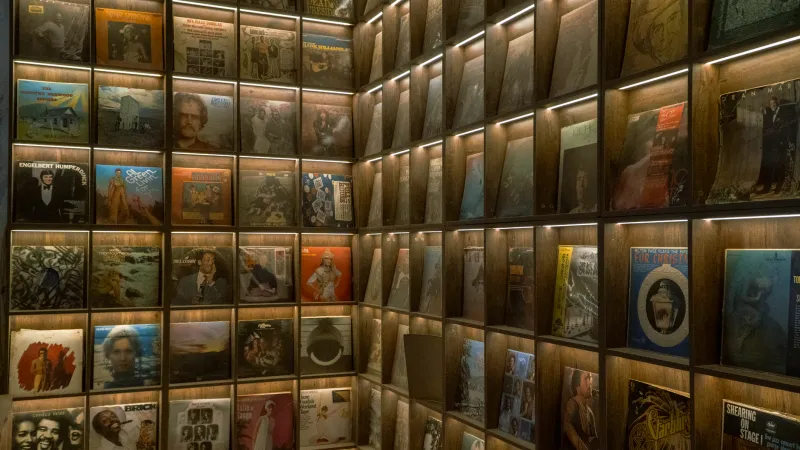
Báo Trần has been collecting Vietnamese recordings for over twenty years. His home in Westminster, California — the heart of Little Saigon — contains what he estimates is one of the largest private collections of pre-1975 Vietnamese music in the United States: thousands of vinyl records, hundreds of cassette tapes, and a growing number of reel-to-reel recordings that he's been acquiring from estate sales, private sellers, and fellow collectors.
"Every time someone passes away and their family doesn't know what to do with the records, there's a chance those recordings disappear," Báo told us during a visit to his collection. "I've bought collections from families who were just going to throw everything away. They didn't know what they had."
What they had, in some cases, was irreplaceable. Báo has recovered recordings of performances that were never commercially released — live recordings from Saigon clubs, private studio sessions, demo tapes that capture artists in unguarded moments between takes. He's also found recordings of musicians who never made it onto official releases at all: local performers whose talent was exceptional but whose careers were cut short by history.
The Digitization Challenge
Finding the recordings is only the first problem. Getting them into a format that can actually be heard — and shared — is another challenge entirely.
Magnetic tape from the 1960s and 1970s is notoriously fragile. Before it can be played, it often needs to be "baked" — literally heated in a controlled environment to temporarily restore the binder that holds the magnetic particles in place. Get the temperature wrong, and you destroy the recording. Get it right, and you might have a narrow window to capture the audio before it degrades again.
Vinyl is more stable, but professional digitization still requires specialized equipment and trained ears. Surface noise, groove damage, and pressing inconsistencies all have to be addressed if the goal is a listenable final product rather than a historical curiosity.
Anna Lê, a sound engineer based in Los Angeles who specializes in archival audio restoration, has worked on several Vietnamese music preservation projects over the past decade. She describes the work as equal parts technical and emotional.
"You're working on something that might be the only copy that exists," she says. "That's a lot of pressure. But it's also incredibly meaningful. There have been sessions where I'm cleaning up a recording and I realize I'm hearing a voice that hasn't been heard in forty years. That's a strange feeling."
Family Keepers
Some of the most significant preservation work isn't happening in studios or archives — it's happening in living rooms, driven by family members who inherited recordings they're only beginning to understand the value of.
Mai-Ly Đặng grew up knowing her grandfather had been a respected musician in Saigon before emigrating to the US in the late 1970s. He rarely talked about his music career, and when he passed away a few years ago, she inherited a box of tapes she couldn't play and sheet music she couldn't read.
"I knew he had been someone in music, but he was so private about it," she says. "After he died, I started reaching out to collectors and archivists to try to figure out what I actually had. It turned out some of those tapes were recordings of him performing with musicians who are now considered legends."
With help from Báo and a digitization grant from a Vietnamese cultural foundation, Mai-Ly has been able to have several of the tapes restored. She's now working with a Vietnamese-American music historian to document the recordings and figure out the best way to share them — a process that involves navigating complicated questions about rights, context, and audience.
Legal Tangles and Moral Questions
The legal landscape around these recordings is genuinely complicated. Many were made informally, with no surviving contracts or clear rights documentation. Some were produced by labels that no longer exist. Others involve composers whose estates are split across multiple countries.
"There's no clean answer," admits James Phú, an entertainment attorney in Orange County who has worked with several Vietnamese music preservation projects. "You have recordings that are historically and culturally significant, but the ownership questions are often unresolvable through traditional legal frameworks. The good news is that most of the family members and collectors involved in this work are motivated by preservation, not profit. That makes informal agreements possible even when formal ones aren't."
Platforms like NhacViet Live are increasingly part of the conversation about where these recovered recordings should live once they're digitized. A streaming platform with a Vietnamese cultural focus can offer something a generic archive can't: an audience that will actually listen, contextualize, and share these recordings as living music rather than historical documents.
Why It Matters Now
There's a generation of Vietnamese Americans — people in their twenties and thirties — who are discovering their parents' and grandparents' music for the first time, often through social media clips and streaming fragments. For them, these recovered recordings aren't just historical artifacts. They're connections to a world they never got to see, carried in sound.
Báo Trần thinks about that audience constantly as he works through his collection, tape by tape.
"This music was made by people who loved making it," he says. "They didn't make it to be forgotten. They made it to be heard. Every recording I save is one more chance for that to happen."
The work is slow, expensive, and often heartbreaking. But the alternative — letting these songs dissolve into silence — is something the people doing this work simply aren't willing to accept.