Living Room to Livestream: How Vietnamese American Musicians Are Reinventing the Concert Experience
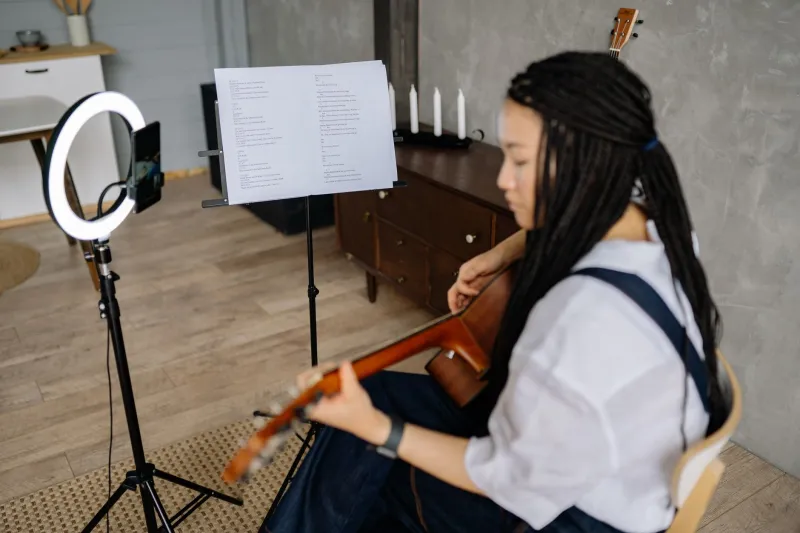
On a Tuesday night in February, singer-songwriter Bảo Châu sat in her apartment in Austin, Texas, a ring light casting a warm glow over her guitar, a cup of tea steaming on the table beside her. Within minutes of going live, over 800 people had tuned in — fans from California, Texas, Virginia, even a handful dialing in from Vietnam and Australia. She played for 90 minutes, took requests in the comments, answered questions between songs, and at one point, stopped mid-set to help a fan figure out a chord progression they'd been struggling with.
No venue. No ticket fees. No opening act. Just an artist and her audience, separated by thousands of miles but somehow closer than most concert experiences allow.
This is the new frontier of Vietnamese American live music, and it's reshaping what it means to perform, connect, and build a career as an artist in the diaspora.
Why Traditional Venues Don't Always Work
Let's be honest: the traditional concert model has never been a perfect fit for the Vietnamese American music scene. The community is geographically scattered — pockets of diaspora life in Orange County, Houston, San Jose, Atlanta, Chicago, and beyond, with no single hub large enough to guarantee a sold-out show every time.
Booking a venue, covering production costs, and pulling an audience from a dispersed community is a logistical and financial challenge that many independent Vietnamese American artists simply can't sustain on a regular basis. Even artists with dedicated fanbases often find themselves playing to half-empty rooms simply because their listeners are spread across the country.
Livestreaming flips that equation entirely.
"When I do a virtual show, I'm not trying to get 200 people to drive to the same spot on the same night," says Minh Đức, a singer-guitarist based in the San Gabriel Valley who has been doing exclusive online performances for the past three years. "I'm reaching people in their homes, on their terms. Someone in Georgia who loves my music doesn't have to miss out just because I'm in California."
The Intimacy Advantage
What's striking about these digital performances isn't just their reach — it's their texture. Livestream concerts by Vietnamese American artists tend to carry a warmth and informality that's genuinely difficult to replicate in a traditional venue setting.
Comments scroll in real time. Artists read names, respond to shout-outs, take song requests, and occasionally drift into storytelling between tracks — sharing the memory behind a song, or explaining a lyric to a younger viewer who's still learning Vietnamese. The whole experience feels less like a performance and more like being invited into someone's home.
"There's a word in Vietnamese — ấm cúng — that means something like cozy, warm, intimate," says Liên Hương, a music writer and cultural commentator based in Houston who covers the Vietnamese American entertainment scene. "That's exactly what these virtual concerts feel like. They're ấm cúng in a way that a lot of big venue shows just aren't."
For diaspora audiences who often experience Vietnamese culture in the context of family gatherings — living rooms, backyards, Tết parties — this intimacy resonates on a deep level. It feels familiar. It feels like community.
Building a New Revenue Model
Beyond the emotional connection, there's a real economic story here. Vietnamese American artists who've embraced the virtual concert format are discovering that it can be surprisingly sustainable — and in some cases, more lucrative than traditional gigging.
Platforms that support paid virtual events allow artists to charge for access, offer tiered experiences (a general admission stream versus a VIP chat session after the show, for example), and sell merchandise directly to their audience during the broadcast. Super chats, digital tips, and fan subscriptions add additional revenue layers that don't exist in a conventional venue setting.
Bảo Châu, the Austin-based singer, says her monthly virtual shows now generate more reliable income than the sporadic venue bookings she used to depend on. "With a live show, you spend weeks promoting, you pay for the space, you deal with sound issues, and then you go home and hope you broke even," she says. "With a virtual show, my overhead is low, my reach is bigger, and I actually get to talk to my fans."
She's also found that the format lets her experiment in ways a traditional gig doesn't allow. She'll test new songs, try different arrangements, play deep cuts she'd never risk on a ticketed stage. Her audience, she says, loves being part of that process.
Community, Not Just Content
Perhaps the most meaningful dimension of this virtual concert movement is what it's doing for community cohesion. For Vietnamese Americans who live far from major diaspora hubs, access to live Vietnamese music has historically been limited to occasional festivals or the rare touring artist passing through town.
A virtual concert changes that calculus completely. A Vietnamese American kid in rural Minnesota, a college student in Vermont, a retiree in Florida — they can all show up for the same performance, share the same comments section, and feel, for 90 minutes on a weeknight, like they're part of something larger than their immediate geography.
"I had someone message me after a show saying it was the first time in months they'd felt connected to their Vietnamese side," says Minh Đức, still visibly moved by the memory. "They'd moved somewhere with basically no Vietnamese community, and they were struggling. And then they found my stream. That means everything to me."
The Road Ahead
As streaming technology improves and Vietnamese American audiences grow more comfortable with the virtual concert format, the potential here is enormous. Artists are already experimenting with multi-camera setups, collaborative streams with other musicians, and hybrid events that combine a small in-person audience with a much larger virtual one.
For platforms dedicated to Vietnamese music and culture, this shift represents both an opportunity and a responsibility — to support, amplify, and celebrate the artists who are doing this work, and to make sure their audiences can find them.
The living room concert economy is real, it's growing, and it's one of the most exciting things happening in Vietnamese American music right now. Don't sleep on it.